Where Overlord Ends and the Collection Toolchain Begins
Overlord build metadata, browser-store selectors, wallet-upload markers and capture components in the Linux agent.
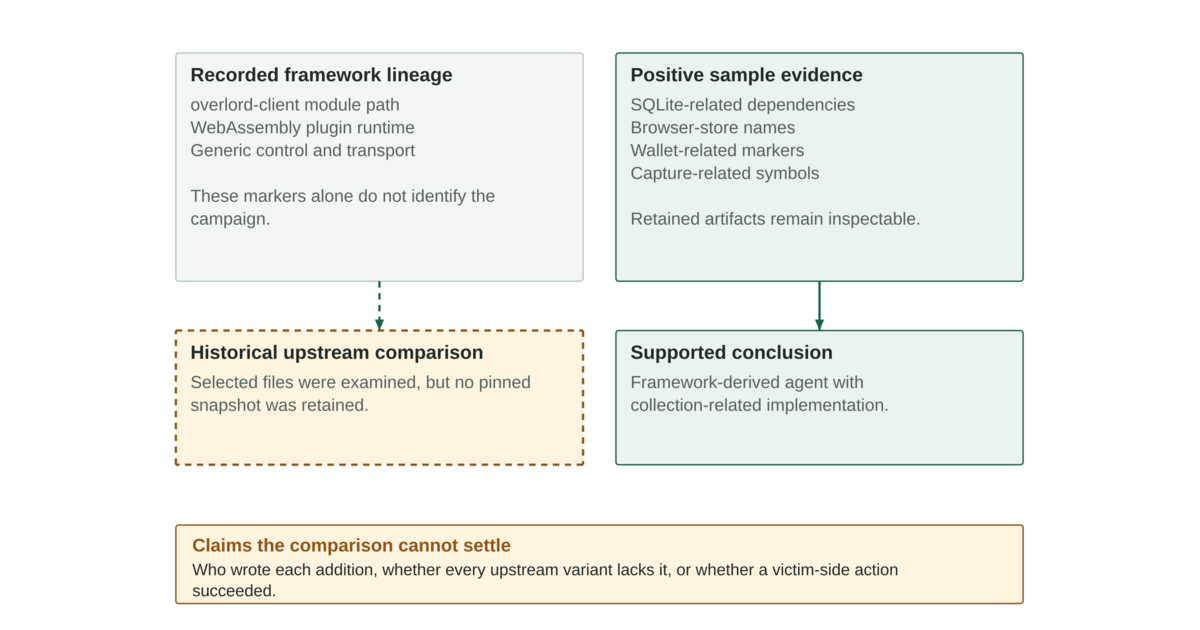
The Linux Go agent embeds the module path overlord-client/cmd/agent, a WebAssembly runtime and SQLite dependencies, and its strings include browser database names, wallet-upload configuration and capture-related symbols; E18 documents the bounded comparison with selected upstream files, while E05 records the sample-specific capture findings. Those components connect a general remote-access framework to the collection functions found in this sample.
The Go build records an Overlord module path
The Linux amd64 artifact is 15,790,242 bytes and has this SHA-256:
ef183bbb40f4c7c3f4b52994cdba3295f3eab2604fdad99eefa3b67b8d966e8d
I read these fields from its Go build information:
path                 overlord-client/cmd/agent
module               overlord-client (devel)
wazero               v1.7.0
modernc.org/sqlite    v1.34.5
CGO_ENABLED          0
GOARCH               amd64
GOOS                 linux
vcs.revision         056221e342357056c8539585806f76632660e414
vcs.time             2026-07-21T01:14:06Z
The module path connects the binary to the Overlord agent codebase, the wazero dependency supplies a WebAssembly runtime (consistent with the framework's plugin support), and SQLite provides local database functionality, which becomes relevant alongside the browser-store markers elsewhere in the file.
The Go build-setting documentation defines vcs.revision as the checkout revision and vcs.time as its associated modification time. The timestamp is version-control metadata. The binary's compilation time remains unverified. The recorded repository lookup did not locate the embedded revision, leaving the corresponding source checkout unresolved.
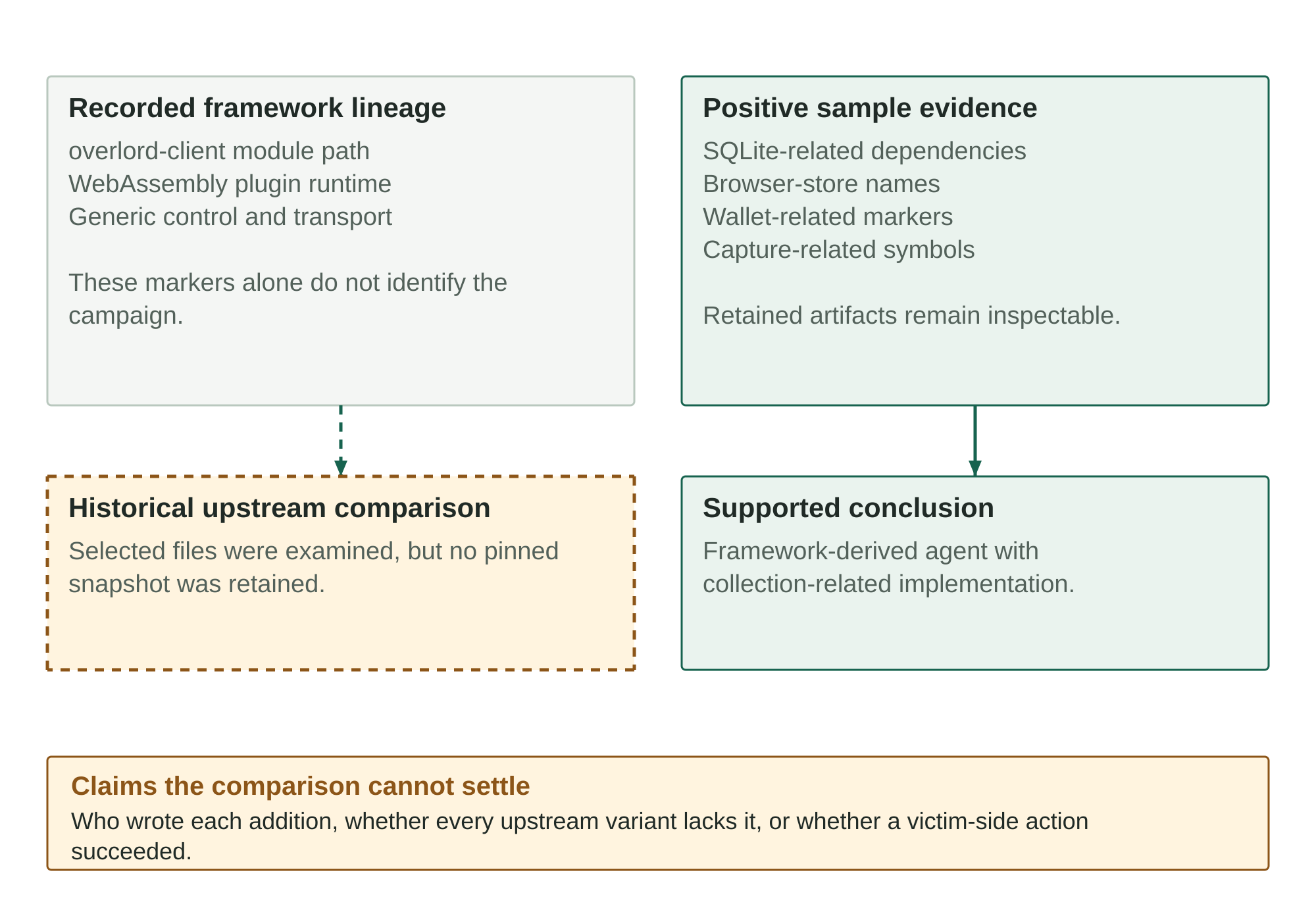
Figure 1. The agent combines Overlord framework markers with browser, wallet and capture-related components.
The upstream files shared generic framework features
The July comparison inspected selected client module and configuration files; it found the shared module path, plugin support and generic transport configuration, and it also recorded a newer wazero version in the examined upstream module file than the sample's v1.7.0. The dependency versions differ. Dating the fork or deployment requires additional records.
SQLite-related dependencies and wallet/browser markers were absent from the selected upstream files, and those files were not retained at a pinned revision, preventing a reproducible source diff; other versions, forks and plugins were not exhaustively compared. The authorship of these components remains unresolved.
Browser stores, wallet selectors, and capture symbols
String examinations found Login Data, Local State, logins.json and key4.db, along with wallet names and extension identifiers. These are browser-store and collection selectors. Together with SQLite, these selectors identify what the agent is built to read, but successful access and decryption on a victim host remain unmeasured.
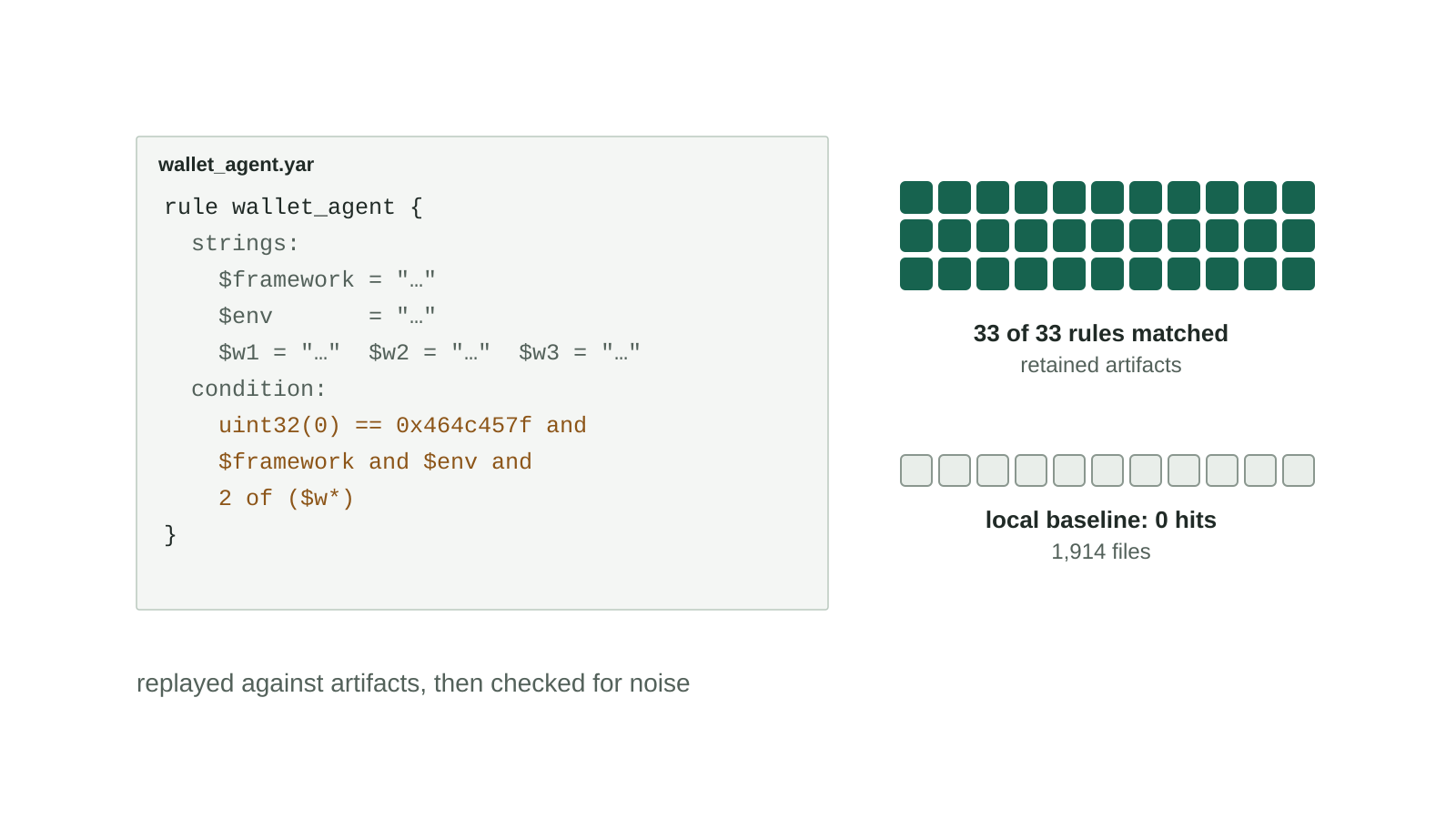
The wallet-related markers include an endpoint setting, a client header and an upload path, and the companion's wallet-agent YARA rule combines these with the Overlord module and server-environment markers. A generic framework match would also identify unrelated Overlord deployments. Requiring wallet context narrows the search to files carrying that additional combination.
The binary also contains previous-frame, block-comparison and capture-loop symbols, which provide evidence of capture-related implementation despite the absence of expected packages in the selected upstream dependency files. The capture analysis examines those symbols and the separate Windows bundle. Display access, code reachability and successful transmission were not reproduced.
The phased JavaScript collection, GUS-prefixed configuration and Windows Node/Python pipeline occur in separate components of the toolchain, and their functions extend the collection paths beyond the Go executable, yet they cannot all be assigned to changes in one agent's source.
For file hunting, the wallet-agent rule and capture-agent rule select different marker combinations. Both remain experimental. A hit identifies content for inspection, and can include source or research material containing those strings. For an unexpected installed agent, preserve its hash, configuration, launch mechanism and outbound destinations alongside the matching offsets.
Originally published on the UNK_DeadDrop research site.
References
- Campaign paper: UNK_DeadDrop: An Artifact-Based Study of Recruitment Malware (PDF)
- Scanner paper: Static AST-Based Triage of Socially-Engineered Developer Lures (PDF)
- Scanner: unk-scanner on GitHub, with rules and inert fixtures
- Series: all fourteen parts on the UNK_DeadDrop research site
About the author
- Independent security researcher and systems engineer based in Berlin. Author of UNK_DeadDrop and unk-scanner. I write about static AST analysis, software supply-chain security, and low-level runtime internals. Currently open to full-time roles in security research, static analysis tooling, or systems engineering.
Comments
Join the discussionNo comments yet. Be the first to comment.
UNK_DeadDrop: Developer-Targeted Recruitment Malware
Six parts from an artifact-led investigation of a fake-recruitment campaign that targeted software developers: a malicious VS Code extension, parse-only deobfuscation, a GitLab dead drop, target harvesting from commit metadata, detection engineering, and the boundary between a public framework and the collection tools. All fourteen parts and both papers are on the research site: https://krasforge.github.io/UNK_DeadDrop/